Industries
OpsChain for Utilities & Energy
The SOCI Act expects governed change on critical infrastructure and evidence that the controls held. OpsChain enforces change governance at the point where the change runs. Approval policies apply on your critical paths, together with enforced outage windows, step-up authentication and a tamper-evident history. This supports the evidence behind your CIRMP attestation, across OT and IT.
Regulatory obligations
SOCI Act and CIRMP risk management
Responsible entities under the SOCI Act must run a critical infrastructure risk management program and stand behind an annual attestation. The attestation covers how operational change on critical assets is governed. OpsChain enforces the change control through approval policies on the path, change windows and an audited break-glass procedure. The change evidence behind your CIRMP attestation is generated as a by-product of normal operation.
OT/IT convergence
The same change may touch a SCADA gateway and the cloud systems around it. OpsChain governs both under one control plane, with one consistent model of approval, change window and evidence across OT and IT. Each path and identity carries an explicit authorisation, and step-up authentication is required before the most sensitive operations.
Wider obligations
The same enforced controls and audited history support the change-control and access-control evidence other programs require, from NERC CIP for bulk electric systems to IEC 62443 control-system security and internal audit. One control plane provides one consistent model of approval and evidence.
Controls OpsChain enforces
- ✓Approval policy enforced on critical-asset paths. Quorum is enforced, self-approval is excluded, and no author can bypass the policy in code.
- ✓Change windows planned by your operations team. Planned work is admitted, other work is refused with a recorded reason, and overrides are visible and audited.
- ✓Impacted-asset-owner approval for the changes with the largest blast radius. Every declared owner must approve.
- ✓Estate classification in your own vocabulary. Criticality is carried as audited metadata on the assets themselves.
- ✓Fingerprinted, masked submission exports. The change packet and the auditor’s evidence are generated directly from the records.
- ✓A hash-chained, tamper-evident history of every change, with your ITSM change record carried end to end.
Separation of duties means the requester can never approve their own change, and quorum counts distinct identities. OpsChain supports your compliance evidence. It does not make you compliant, and no platform does.
Worked scenario: LimeGrid's SCADA gateway patch
LimeGrid is a fictitious energy utility from our Lime Group worked scenario. It lets us show real mechanisms on a realistic estate without showing any customer's production environment.
The policy
The change governance administrator binds two policies to LimeGrid production. Release managers must approve every change. Patch actions on the control network additionally require approval from the OT engineering team, with strict enforcement and a required change window. No workflow is edited.
The proposal
An engineer submits the SCADA gateway patch against the production control network with its change record. The change holds in pending approval. Nothing is queued or provisioned. His attempt to approve his own change is refused, and the refusal names him as the requester.
The decision
The release manager reviews the checklist: the prior test-environment run, the content fingerprint and the CR reference. The release manager approves on the record, and the OT lead approves the strict line. Rejection is an equally valid outcome. It is recorded as a row of its own, with who rejected the change, when and why.
The window
Approval does not start the change. The patch waits for the planned outage window and starts inside it. Ad-hoc work attempted during the window is refused. The window record is the change plan, and it is enforced.
The evidence
On completion, a masked, fingerprint-stamped submission export records who requested the change, who approved it, what ran and in which window. The export is rendered from the authoritative records your CIRMP attestation stands on. An emergency break-glass path is also available for the 2 a.m. incident. It requires a reason, and every use is audited.
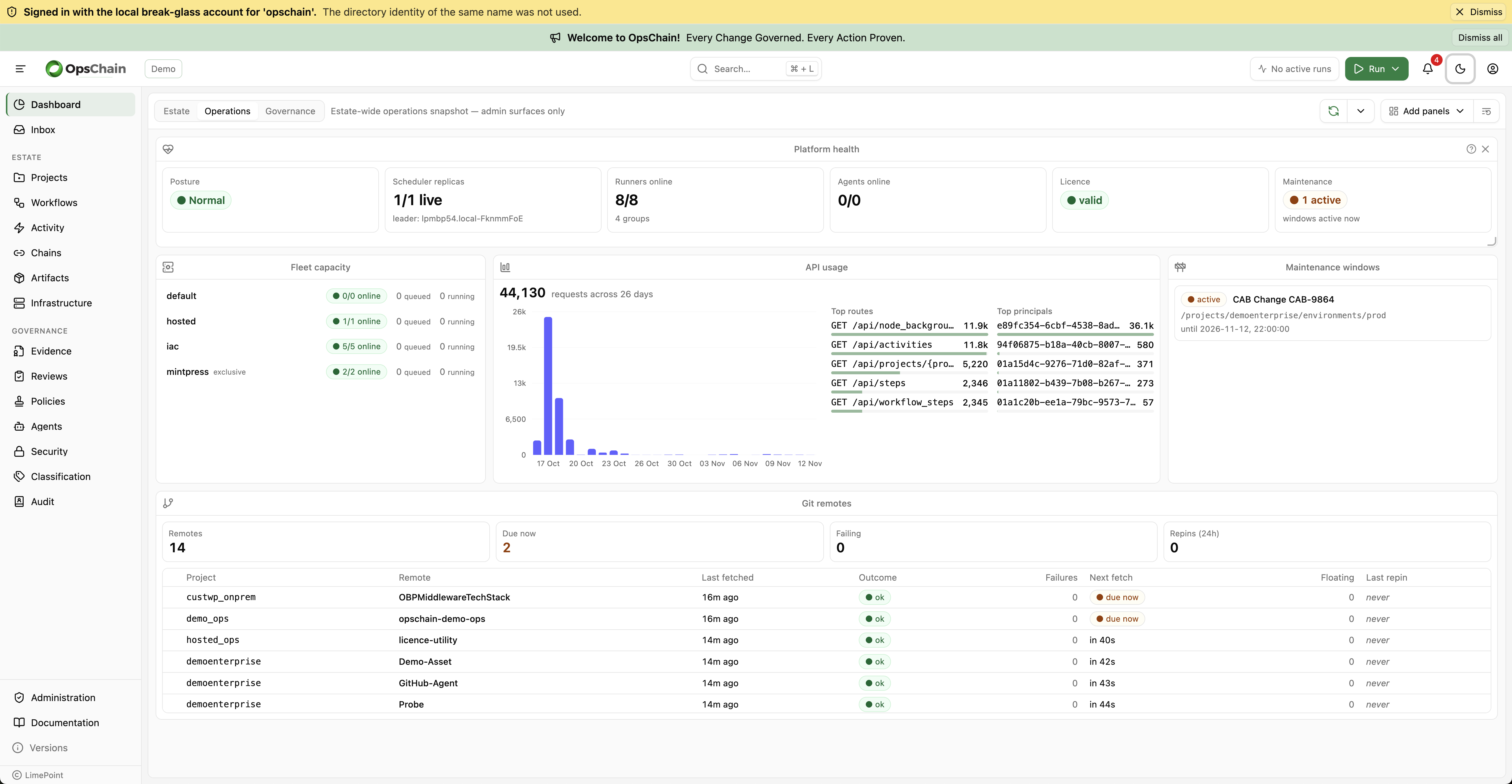
The same walkthrough runs live in our demo, in your vocabulary and on an estate shaped like yours.
Governed AI on critical infrastructure
When you are ready to use AI on an estate this critical, the controls come first. AI operators start supervised and are elevated to autonomous only on recorded evidence, through a governed approval. Your criticality classifications can cap their authority on the assets that matter most. Every proposal passes through the same approval process, and an emergency stop is always one action away.