Industries
OpsChain for Telecommunications
SOCI and TSSR expect governed change on carrier networks and evidence that the controls held. OpsChain enforces change governance at the point where the change runs. Approval policies apply on your sensitive network paths, together with enforced maintenance windows, step-up authentication and a tamper-evident history, across network, IT and cloud operations.
Regulatory obligations
SOCI Act obligations for carriers
Carriers are responsible entities under the SOCI Act. They must run a risk management program, govern operational change on critical assets, and hold the evidence behind the annual attestation. OpsChain enforces the change control through approval policies on the path, change windows and an audited break-glass procedure. The change evidence is generated as a by-product of normal operation.
TSSR security of networks and facilities
TSSR obligations require carriers to protect networks from unauthorised access and interference, and to show how change to sensitive parts of the network is controlled. OpsChain gives every actor an explicit authorisation and requires step-up authentication before the most sensitive operations. Every decision is recorded in a hash-chained, tamper-evident history.
Wider obligations
The same enforced controls and audited history support the change-control and access-control evidence your other programs require, including network security standards, customer-data obligations and internal audit. One control plane spans network, IT and cloud operations and provides one consistent model of approval and evidence.
Controls OpsChain enforces
- ✓Approval policy enforced on sensitive network paths. Quorum is enforced, self-approval is excluded, and no author can bypass the policy in code.
- ✓Change windows planned by your network operations team. Planned work is admitted, other work is refused with a recorded reason, and overrides are visible and audited.
- ✓Impacted-asset-owner approval for the changes with the largest blast radius. Every declared owner must approve.
- ✓Estate classification in your own vocabulary. Criticality and sensitivity are carried as audited metadata on the assets themselves.
- ✓Fingerprinted, masked submission exports. The change packet and the auditor’s evidence are generated directly from the records.
- ✓A hash-chained, tamper-evident history of every change, with your ITSM change record carried end to end.
Separation of duties means the requester can never approve their own change, and quorum counts distinct identities. OpsChain supports your compliance evidence. It does not make you compliant, and no platform does.
Worked scenario: LimeTel's subscriber-batch rehome
LimeTel is a fictitious carrier from our Lime Group worked scenario. It lets us show real mechanisms on a realistic estate without showing any customer's production environment.
The policy
The change governance administrator binds two policies to LimeTel production. Release managers must approve every change, and work on the provisioning platform carries its own strict approver line. No workflow is edited.
The proposal
An engineer submits a subscriber-batch rehome against the production provisioning platform with its change record. The change holds in pending approval. Nothing is queued or provisioned. Her attempt to approve her own change is refused, and the refusal names her as the requester.
The decision
The release manager reviews the checklist: the prior test run, the content fingerprint and the CR reference. The release manager approves on the record. Rejection is an equally valid outcome. It is recorded as a row of its own, with who rejected the change, when and why.
The window
Approval does not start the change. The rehome waits for the planned maintenance window and starts inside it. Ad-hoc work attempted during the window is refused. The window record is the change plan, and it is enforced.
The evidence
On completion, a masked, fingerprint-stamped submission export records who requested the change, who approved it, what ran and in which window. The export is rendered from the authoritative records behind your SOCI attestation and TSSR discussions. An emergency break-glass path is also available for the 2 a.m. incident. It requires a reason, and every use is audited.
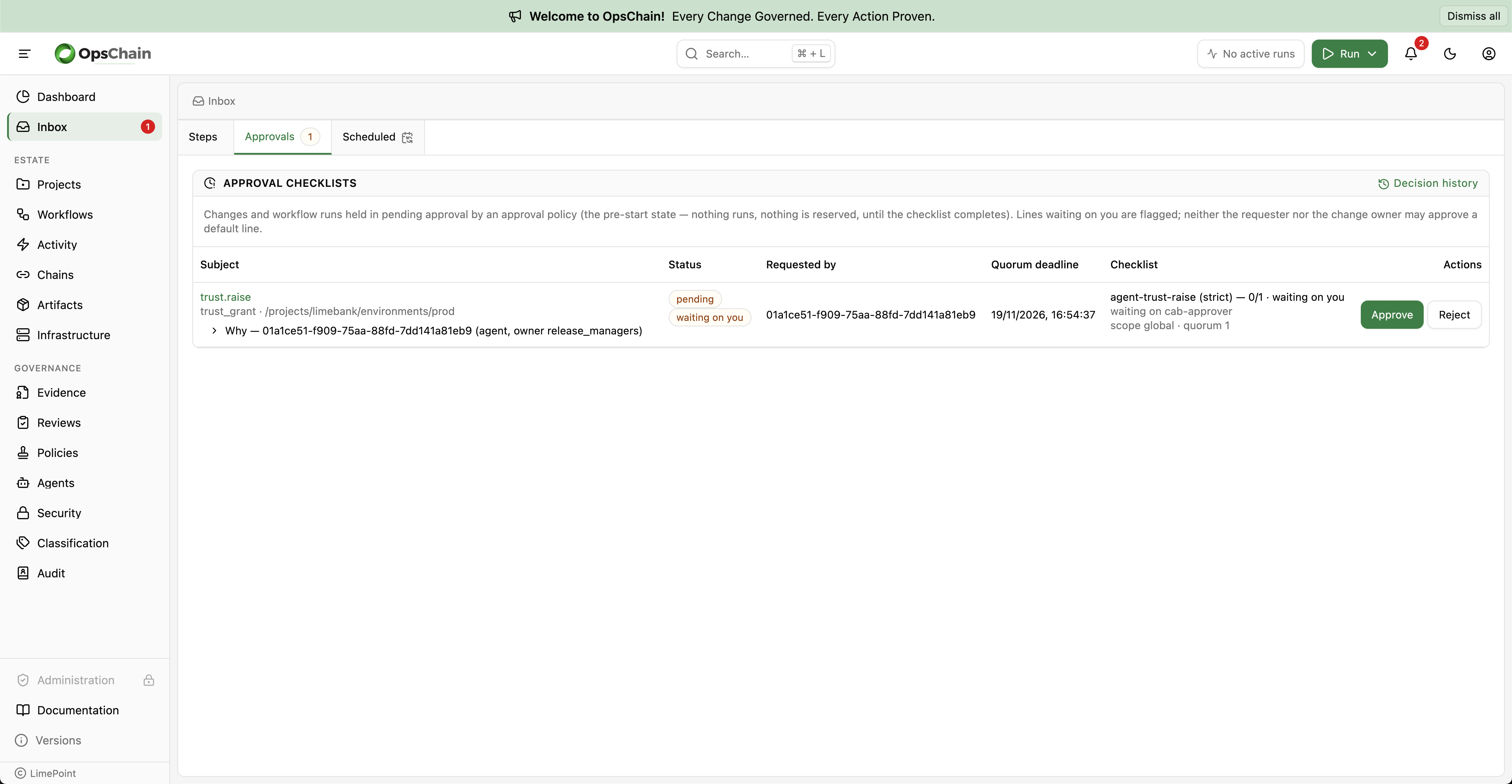
The same walkthrough runs live in our demo, in your vocabulary and on an estate shaped like yours.
Governed AI in network operations
When you are ready to use AI on a carrier estate, the controls come first. AI operators start supervised and are elevated to autonomous only on recorded evidence, through a governed approval. Your sensitivity classifications can cap their authority on the systems that matter most. Every proposal passes through the same approval process, and an emergency stop is always one action away.